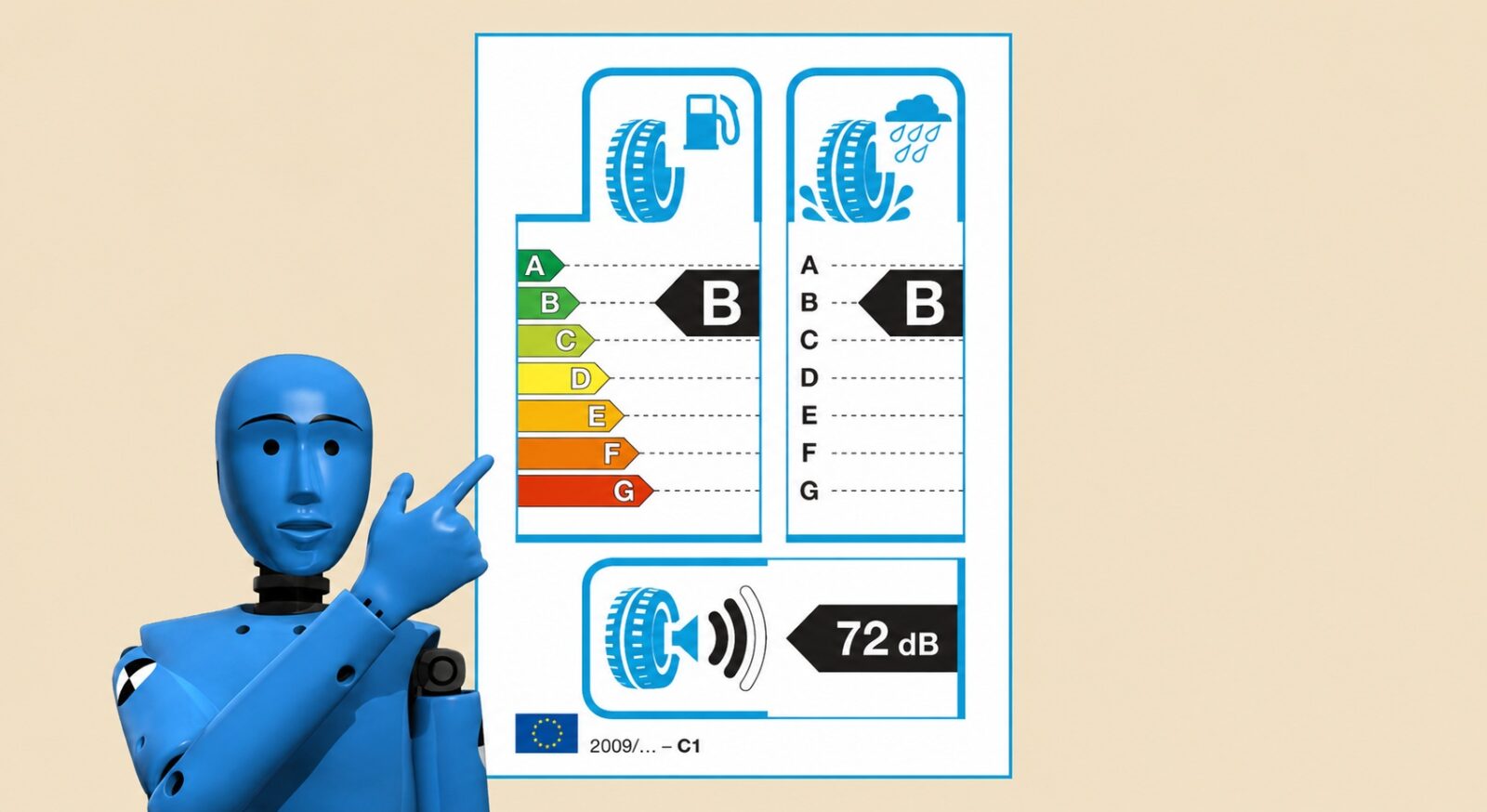


As of 01/05/2021, the European tire label has changed significantly on the basis of updated, stricter European regulations (Regulation (EU) 2020/740). This new European tire label applies to passenger car tires (C1), light truck tires (C2) and heavy truck tires (C3).
The new compulsory European tire label must be shown on the tire or at the point of sale of all C1, C2 and C3 tires produced from 1 May 2021. The label will show the tire’s efficiency, environmental friendliness and safety. It also indicates the performance of tyres specifically designed for use in severe snow and ice conditions. The tire label allows for comparison of tires and aims to encourage the use of safer, more efficient and quieter tires.
However, the label only lists 5 performance criteria when there are actually 50 performance criteria for assessing the quality of a tire. For example: wear resistance (mileage), braking on dry surfaces, traction on snow, lateral grip on ice, vehicle noise, handling and aquaplaning.
The tyre label provides a value (class) for the following five criteria:
Rolling Resistance
The rolling resistance of a tyre is linked to the amount of energy used to move the vehicle it is fitted to: such resistance is related to a number of aspects, including:
The higher the rolling resistance, the less range your vehicles has with the same energy (or, conversely, the higher the fuel consumption for the same covered distance). Rolling resistance is a parameter with a relevant impact on economic aspects, on top of the environmental ones (such as CO2 emissions if the fuel is not from renewable origin). The difference between each class can mean on average a difference of 80 litres of fuel consumption in an internal combustion car during the tyre lifetime or tens of kilometres of range for each charge for a battery electric vehicle.
The wet grip class is a critical safety feature, relating to the distance the vehicle takes on wet asphalt to stop when brakes are pushed hard. Tyres are rated A (the shortest braking distance) to E (the longest braking distance). In an emergency situation, a few metres can even save a life. The difference between a class and another can mean an extra 3-6 metres on the stopping distance. Wet grip decreases when the tread is worn and the risk of aquaplaning increases.
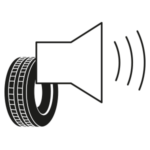
The external rolling noise relates to the noise produced by the tyre and perceived by a person when a vehicle passes by. It is measured in dB(A) (A-weighted decibels). Noise classes range from A (less noise outside the vehicle) to B (more noise). Noise levels in the C class are only allowed for very specific tyres (because in restriction introduced by type approval legislation. By choosing a tyre with a good noise rating you lower the impact of your driving on the surrounding environment. A difference of 3dB doubles the amount of external noise the tyre produces. Tyres with a low noise level have between 67 and 71 dB, the highest levels are up to 77 dB.
This noise is different from the “cavity noise”, caused by resonance of the air inside the tyre cavity during rotation and that is propagated, via rims and organs, to the vehicle cabin (no rating exist for this noise).

Winter tyres approved for use in severe snow conditions can be recognised by a specific pictogram, called the « Alpine symbol » or 3PMSF (3 Peaks Mountain with Snow Flake), that is also moulded on the tyre sidewall of such tyres. To bear the pictogram, the tyre has to pass a specific test, by measuring the braking distance of a car launched on compacted snow. For trucks, the pictogram is granted by measuring the acceleration performance of a tyre on such snow. Snow grip performance in general is tested in accordance with Annex 7 to UNECE Regulation No 117 that describes in detail factors as test surface, air temperature, testing vehicle, load, pressure, speed and more.

Nordic winter tyres, or ice tyres, approved for use in extremely cold conditions can be recognised by an additional specific pictogram, representing an ice stalagmite.These tyres provides a shorter braking distance on ice covered roads in winter and tests are according to the ISO standard 19447 (only C1 tyres, for passenger cars). These tyres are available in Nordic countries to be used only in those extremely cold winter conditions. Usually they have very poor performance on a wet surface, thus should not be used in southern countries. To bear the pictogram the tyre has to pass a specific test for braking on completely iced surface.

The EU has a European Product Database for Energy Labelling (EPREL). The tire (label) data in the database can be consulted as of 1 May 2021. The new tire label will also contain a QR code with which the data from the product information sheet, as referred to in Annex III of Regulation (EU) 2020/740, will eventually be available to everyone.
With reference to the aforementioned European Regulation (EU) 2020/740, we emphasise that driver behaviour is the primary determinant of fuel consumption and road safety, and in particular that:
This Regulation does not apply to:
Source: Regulation (EU) 2020/740 of the European Parliament and of the Council
 Technology
 Technology
 Technology
 Technology
 Technology
 Technology
 Technology
 Technology

English

French

Lao

Mongolian

Spanish

Vietnamese
Fill out the form below and a member of our team will get back to you promptly.

Whether you're a distributor, fleet operator, or OEM partner, we'd love to discuss how NEXXUS can deliver value to your business. Get in touch with our global sales team today.