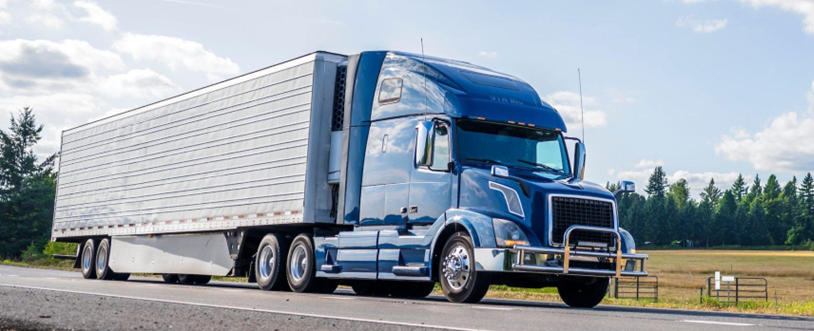


Trucks keep the world moving. They carry goods and materials between ports, factories, stores, and work sites. On every trip, their tires carry the load and grip the road. Choosing the right tires can improve safety, extend tire life, and help control running costs.
Tire size alone is not enough. A highway tractor runs long miles, a dump truck hauls heavy loads, and a city delivery truck makes constant stops. Even on the same truck, tire needs change with axle position.
In this article, we’ll explain the difference between tire load and speed ratings, show how axle configurations and working conditions affect tire choice, and walk through four steps for choosing the right tires.
Truck weight classes and tire load ratings are two different things. A weight class describes the truck’s maximum rated weight. A tire’s load rating shows how much weight that tire can carry. When choosing tires, check the load on each axle, not just the truck’s weight class. [6]
Weight classes vary by market. Many markets, including the EU, China, and India, use or follow the vehicle classification of the United Nations Economic Commission for Europe (UNECE). It groups vehicles into category M (passengers), N (goods), and O (trailers). Goods vehicles are divided into N1 (up to 3.5 tonnes), N2 (over 3.5 to 12 tonnes), and N3 (over 12 tonnes). [1–3]
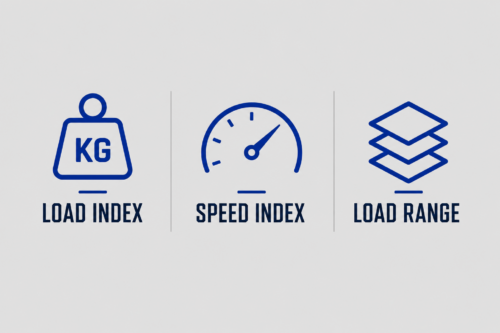
Truck tires also have a load index (LI) and a speed symbol. The load index shows how much weight a tire can support under specified conditions. The speed symbol shows its rated speed at that load. Some truck tires have two load indices, one for single fitment and one for dual fitment. [4, 6]
| Load index | Maximum load per tire | Load index | Maximum load per tire |
| 140 | 2,500 kg | 156 | 4,000 kg |
| 144 | 2,800 kg | 157 | 4,125 kg |
| 148 | 3,150 kg | 160 | 4,500 kg |
| 150 | 3,350 kg | 164 | 5,000 kg |
| 152 | 3,550 kg | 167 | 5,450 kg |
| 154 | 3,750 kg | 170 | 6,000 kg |
| Speed symbol | Rated speed |
| F | 80 km/h |
| G | 90 km/h |
| J | 100 km/h |
| K | 110 km/h |
| L | 120 km/h |
| M | 130 km/h |
| N | 140 km/h |
Take 315/80R22.5 156/150L as an example, 156 = 4,000 kg per tire in single fitment; 150 = 3,350 kg per tire in dual fitment; L = 120 km/h. [4] Please read these values with the tire manufacturer’s load and inflation data and specified service conditions. [4, 6]
These ratings help you check a tire’s load capacity, but they don’t tell you which size or tread pattern to choose. For that, you also need the tire size approved for the vehicle, the axle configuration, and the operating conditions.
A tire’s load rating applies to one tire, so you also need to know how many tires share each axle’s load, and that depends on the truck’s axle and drive configuration.
In a configuration such as 4×2, 6×2 or 6×4, the first number counts wheel positions and the second counts driven wheel positions. Each axle normally contributes two positions, one on each side. A pair of dual tires counts as one position, so the code does not tell you how many individual tires are fitted. [5]
Whatever the axle positions, the tire must first meet the fitment, load and speed requirements. [6, 7] For tire selection, axle position matters. Steer tires need stable handling, drive tires need traction, and trailer tires mainly carry load and need durable, even wear.
| Main role | Performance to compare | |
| Steer | Controls vehicle direction and carries the front load | Handling stability, wet grip and even wear |
| Drive | Delivers engine power to the road and moves the vehicle forward | Traction, wear and suitability for the application |
| Trailer | Carries the trailer load while following the tractor | Load capacity, rolling resistance and resistance to sideways scrubbing |
But axle position is only part of the picture. The roads a truck travels on and the work it does also affect which tires are suitable.
Axle position tells you where a tire goes. The route affects how a tire wears and what can damage it. Truck operations commonly fall into the following three groups. [7]
| Operation | Typical conditions and tire stresses |
| Long haul highway transport | Long distances on paved roads, with sustained road speeds and heat buildup during continuous running. |
| Regional transport | A mix of local roads and highways, with frequent stops, turns and reversing. Curb contact and sideways tread scrubbing can contribute to wear and damage. |
| Mixed road and construction work | Travel between paved roads and gravel, mud or construction sites. Potholes, slopes and sharp stones can cause cuts and tear pieces from the tread. |
Many trucks work across more than one group. A dump truck may spend most of its trip on a paved road before entering a site; a regional delivery vehicle may also make longer highway journeys. A gravel access road and a quarry with sharp exposed rock can present very different risks.
So, when choosing tires, describe the actual route, road surfaces, distance, speed, and load changes. The vehicle type alone does not define the application. With the axle position and operating conditions identified, you can now work through the four steps for choosing tires.
Now put these pieces together. A suitable tire must fit the vehicle, meet its load and speed requirements, be approved for the axle, and suit the work. Settle these before comparing expected service life and price.
Start with the tire sizes approved by the vehicle manufacturer. Check the vehicle’s tire placard, manual or technical specifications, then compare them with the markings on the current tire. A sidewall photo helps identify what is fitted, but it does not by itself confirm that the fitment is approved. [6]
Also check the rim specification, single or dual fitment, clearances, and whether the assembly needs tube-type or tubeless tires. For duals, confirm the required spacing between the two tires. [6]
Check the rated axle load, the load actually carried in service, and the speed the truck needs. Read these against the tire’s load index, speed symbol, and the manufacturer’s load and inflation tables. Where two load indices are shown, use the first for single fitment and the second for each tire in a dual assembly. [4, 6]
Steer, drive, and trailer axles place different demands on a tire, so confirm that the manufacturer permits the product on the intended axle. Whatever the position, the tire must first meet the fitment, load, and speed requirements. Even an “all-position” tire needs its permitted axles and operating conditions checked. [7]
Once the tire meets the fitment, load, speed and axle requirements, compare the features that matter on the actual route.
For long haul highway work, compare rolling resistance, tread wear, heat buildup and wet grip. Lower rolling resistance can help reduce fuel use, but it needs to be considered alongside the other requirements. [6, 7]
Why the current tires are replaced is often a useful clue. If they reach normal tread wear limits, mileage may be a priority. If cuts, missing pieces of tread or irregular wear force early replacement, investigate the cause before choosing the next tire. [6]
If you are choosing tires for your fleet or customers, a few details are enough to start a useful discussion with NEXXUS Tires. Please share:
References and Data Sources
[1]Regulation (EU) 2018/858, Article 4 — vehicle categories M, N and O.
Category N weight thresholds.
[2]SAMR — GB/T 15089-2001, Classification of power-driven vehicles and trailers.
Official standards record; equivalent adoption of ECE R.E.3.
[3]India MoRTH — VAHAN Homologation, vehicle categories.
Category N1, N2 and N3 definitions.
[4]UN Regulation No. 54 — commercial vehicle and trailer tires, official EUR-Lex text.
Sections 2.27–2.29 and Annex IV: load indices and speed symbols.
[5]MAN — eTruck towing guide, wheel configuration, p. 24.
Wheel positions, driven wheels and the counting of twin tires.
[6]USTMA — Care and Service of Commercial Truck and Bus Tires, 2017.
Chapters 1–3: sidewall ratings, inflation, loading, fitment and replacement.
 Technology
 Technology
 Technology
 Technology
 Technology
 Technology
 Technology
 Technology

English

French

Lao

Mongolian

Spanish

Vietnamese
Fill out the form below and a member of our team will get back to you promptly.

Whether you're a distributor, fleet operator, or OEM partner, we'd love to discuss how NEXXUS can deliver value to your business. Get in touch with our global sales team today.